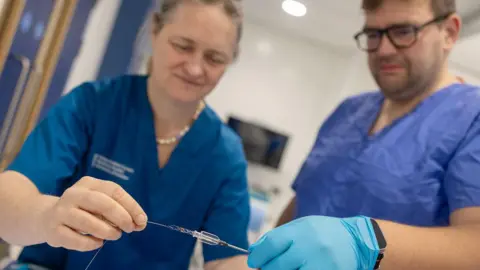
Surgeons from the Scottish region and America have successfully completed what is considered a historic brain operation using robotic technology.
Prof Iris Grunwald, associated with a medical institution, executed the remote thrombectomy - the extraction of blood clots following a cerebral event - on a donated body that had been donated to medical science.
The surgeon was located at a medical facility in Dundee, while the specimen being treated with the machine was at another location at the research facility.
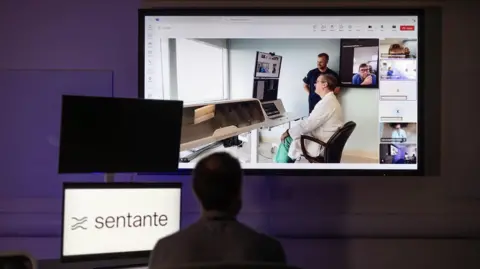
Later that day, Ricardo Hanel from the US location utilized the system to perform the pioneering long-distance operation from his American facility on a donated cadaver in the Scottish city over 6,400km away.
The research collective has described it as a potential "transformative advancement" if it gains clearance for medical treatment.
The doctors think this technology could transform stroke treatment, as a slow access to specialist treatment can have a significant effect on the chances of recovery.
"It felt as if we were seeing the initial vision of the next generation," said the lead researcher.
"While in the past this was thought to be science fiction, we showed that every step of the procedure can currently be accomplished."
The University of Dundee is the global training center of the global medical association, and is the sole location in the UK where doctors can operate on cadavers with human blood circulated in the vessels to replicate operations on a living person.
"This was the first time that we could conduct the entire surgical process in a genuine medical subject to show that each stage of the surgery are feasible," stated the lead expert.
Juliet Bouverie, the chief executive of a stroke charity, labeled the intercontinental surgery as "a remarkable innovation".
"For too long, people living in isolated regions have been deprived of access to surgical intervention," she stated.
"This type of automation could address the disparity which persists in brain care nationwide."
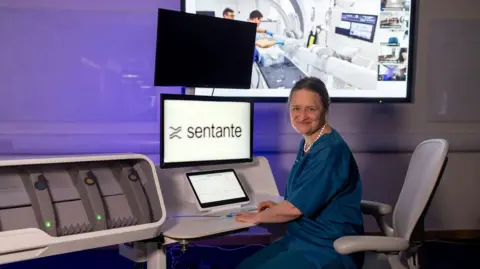
How does the technology work?
An blockage stroke occurs when an artery is blocked by a obstruction.
This interrupts vascular flow to the brain, and neural cells lose function and expire.
The optimal therapy is a clot removal, where a expert uses medical instruments to clear the obstruction.
But what transpires when a person cannot access a expert who can perform the surgery?
The lead researcher explained the study showed a robot could be attached to the same catheters and wires a specialist would normally use, and a medical staff who is with the patient could readily join the tools.
The expert, in a different place, could then hold and move their individual tools, and the robot then carries out comparable motions in real time on the subject to carry out the clot removal.
The subject would be in a treatment center, while the specialist could carry out the procedure via the technological system from anywhere - even their private dwelling.
The medical expert and the neurosurgeon could observe real-time imaging of the specimen in the experiments, and monitor progress in live conditions, with the lead researcher stating it took only 20 minutes of training.
Tech giants Nvidia and Ericsson were contributed to the research to secure the communication link of the robot.
"To operate from the United States to the Scottish nation with a brief latency - a moment - is absolutely amazing," stated the neurosurgeon.
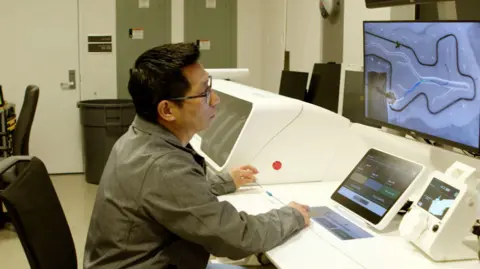
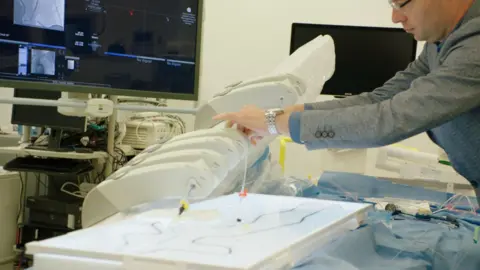
Innovations in cerebral healthcare
The medical expert, who has received recognition for her research and is also the vice president of the World Federation for Interventional Stroke Treatment, said there were primary challenges with a traditional procedure - a global shortage of specialists who can conduct it, and treatment depends on your physical place.
In the region, there are merely three sites individuals can access the surgery - urban centers. If you reside elsewhere, you must commute.
"The intervention is highly dependent on timing," stated the lead researcher.
"Each six-minute postponement, you have a one percent reduced probability of having a positive result.
"This system would now deliver a novel approach where you're not depending on where you reside - saving the crucial moments where your cerebral matter is otherwise dying."
Healthcare information showed there were {9,625 ischaemic strokes|numerous cerebral events|


